I once heard a man say that writing a novel was much easier than writing a short story. In a short story, every word must do the work of many. “The work of writing a novel is writing many words, throwing them down on the paper and hoping that some of them stick.” If such is the truth between novel writing and short story writing, the same is certainly true between long poems and short poems. So when we compare a poem of 22 verses to say, a poem of 3 verses, it would do us well to examine carefully every word in the shorter poem in minute detail.
The first word of Psalm 133 is an important one. The Hebrew ( הִנֵּה )“hinnêh”, the NASB translates as “Behold”. The word is an invitation to see and listen to every word in this short psalm. The force of the word is intense. It means “to look, examine, gaze at this thought, meditated upon it and note it well.” It is an invitation to look closely, to meditate long, examine something in detail, to ruminate and reflect, to drink deeply at a well that will both refresh and renew. Unfortunately, some translations lose the word and the result is that the reader has no chance to measure its worth or heed its instruction.
The outline of the psalm is simple:
- A command to “Behold” (vs. 1a)
- A picture to remember, “how good and pleasant it is when brothers dwell in unity!” (vs. 1b)
- Two similes to investigate so that you see and remember the right things (vss. 3-4)
Verses 2 and 3 both begin with the words “It is like . . .” and then give two illustrations of what “How good and pleasant it is when brothers dwell in unity.”
But the metaphors we are given are not easy to discern. It will take real thought to mine this gold. So here are some things to examine.
- Remember and think hard about when this psalm was used in ancient Israel’s worship.
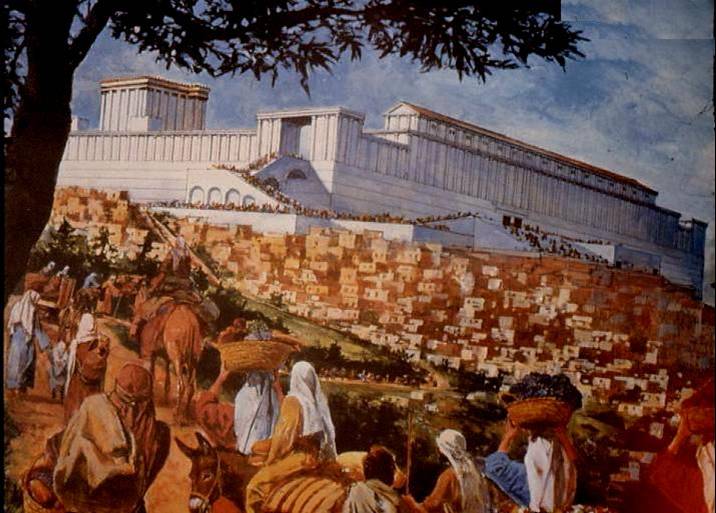
- Imagine the throngs of people coming from all corners of the world on pilgrimage to Jerusalem on the Day of Atonement or for Passover. We are being invited to “Behold” something closely.
- Look just as hard at the imagery of “oil on the head . . .?
- What did it smell like?
- When did people smell that particular oil?
- What was the situation in which these sights and smells would have been experienced?
- Look closely and think hard about the “dew of Hermon . . .”
- What did the dew of Hermon do on the lower slopes of the mountain?
- How did the people in the shadow of Hermon experience the dew?
- How is the oil on Aaron’s beard/robe and the dew of Hermon like “How good and pleasant it is when brothers dwell in unity”?
These are the keys to understanding the Psalm. But you don’t and won’t understand the psalm until you behold all of this in context and are driven to wonderment about the goodness of unity in the worshiping body of Israel, or, in our time, the church.
And remember, when you have seen it, when you have beheld it, there will be still more to see tomorrow and more still every day after tomorrow.
A Song of Ascents. Of David
133 Behold, how good and pleasant it is
when brothers dwell in unity!
2 It is like the precious oil on the head,
running down on the beard,
on the beard of Aaron,
running down on the collar of his robes!
3 It is like the dew of Hermon,
which falls on the mountains of Zion!
For there the Lord has commanded the blessing,
life forevermore.
Meditate on the Word of the Living God. Meditate until “wonderment” floods your spirit and worship pours out of your heart.

 ChosenRebel's Blog