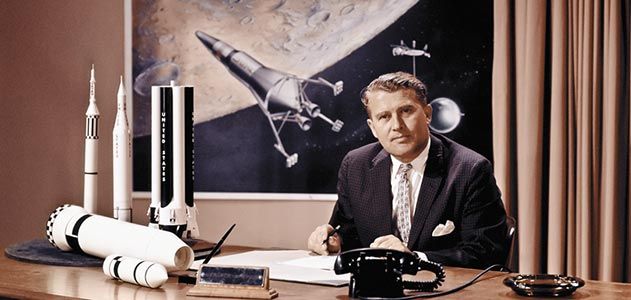
I’m doing a year end clean-out of old files and documents as a result of a friends challenge at an early-morning breakfast, to take some of all my teaching over the years and make it available in some kind of on-going video / youtube training. Not sure I am going to do it yet, but it is worth considering. Maybe. Anyway. I opened up the file cabinet and starting perusing two and have inches of files on Genesis 1-2 and found a gem worth passing on. It is not something I wrote but something the folks at the Kairos Journal put together some years ago.
Born in Wirsitz, Germany, Wernher von Braun was one of the pioneers of modern rocket science. Though he served the German V-2 rocket program in World War II, he ran afoul of Nazi authorities and was arrested when he persistently expressed his preference for designing rockets for outer space rather than war.1 As Germany was collapsing, he turned himself over to the Americans and soon became one of the foremost scientific minds in the United States. Remembered as the father of America’s space program, he led the development of the Jupiter rocket that launched America’s first satellite into space, as well as the Saturn V rocket which carried the first human beings to the moon. Unlike so many of his scientific colleagues, however, von Braun believed there was more to reality than the natural world. The very grandeur of the cosmos itself—the one he had dedicated his life to exploring and understanding—convinced him beyond all doubt that the universe did not come about by chance. It had a Creator.
Science and religion are not antagonists. On the contrary, they are sisters. While science tries to learn more about the creation, religion tries to better understand the Creator. . .
For me the idea of a creation is inconceivable without God. One cannot be exposed to the law and order of the universe without concluding that there must be a divine intent behind it all.
Some evolutionists believe that the creation is the result of a random arrangement of atoms and molecules over billions of years. But when they consider the development of the human brain by random processes within a time span of less than a million years, they have to admit that this span is just not long enough. Or take the evolution of the eye in the animal world. What random process could possibly explain the simultaneous evolution of the eye’s optical system, the nervous conductors of the optical signals from the eye to the brain, and the optical nerve center in the brain itself where the incoming light impulses are converted to an image the conscious mind can comprehend?
Our space ventures have been only the smallest of steps in the vast reaches of the universe and have introduced more mysteries than they have solved. Speaking for myself, I can only say that the grandeur of the cosmos serves to confirm my belief in the certainty of a Creator. . .
Although I know of no reference to Christ ever commenting on scientific work, I do know that He said, “Ye shall know the truth, and the truth shall make you free.” Thus I am certain that, were He among us today, Christ would encourage scientific research as modern man’s most noble striving to comprehend and admire His Father’s handiwork. The universe as revealed through scientific inquiry is the living witness that God has indeed been at work.
When astronaut Frank Borman returned from his unforgettable Christmas, 1968, flight around the moon with Apollo 8, he was told that a Soviet Cosmonaut recently returned from a space flight had commented that he had seen neither God nor angels on his flight. Had Borman seen God? the reporter inquired. Frank Borman replied, “No, I did not see Him either, but I saw His evidence.”2
Footnotes:
- Footnotes:“Wernher Von Braun,” Wikipedia: The Free Encyclopedia Website, http://en.wikipedia.org/wiki/Wernher_von_Braun (accessed August 24, 2005).
- Wernher von Braun, foreword in Harold Hill, From Goo to You by Way of the Zoo (Plainfield, NJ: Logos International, 1976), xi-xii.
Von Braun was a controversial figure. As a former member of the Nazi party, he was early viewed with great suspicion, and rightly so. At the same time, his reasons for turning himself in to the Americans rather than the Russian is both telling and prophetic related to how his life progressed after the war. He lived for 20 years in Alabama, and became a staunch anti-segregationist. Known as a ladies man in his youth in Germany, he married and raised a family in America, met with both Billy Graham and Dr. Martin Luther King and experienced a profound conversion to Christ. He chose the American’s over the Russian because he intuitively felt, even before his conversion, that the Christian worldview was a better protective barrier to the dangerous technology of his scientific discoveries. To this I will add one more quote from the wikipedia bio on von Braun.
After the surrender, Wernher von Braun spoke to the press:
We knew that we had created a new means of warfare, and the question as to what nation, to what victorious nation we were willing to entrust this brainchild of ours was a moral decision more than anything else. We wanted to see the world spared another conflict such as Germany had just been through, and we felt that only by surrendering such a weapon to people who are guided not by the laws of materialism but by Christianity and humanity could such an assurance to the world be best secured.[79]
[79] Arts & Entertainment, Biography (1959–1961 series). Mike Wallace, television biography of Wernher von Braun, video clip of the press statement.

 ChosenRebel's Blog